
-
What is compost?
Compost is an organic fertilizer obtained as a result of the natural process of decomposition of organic materials under the influence of the activities of micro and macro organisms. Ready compost is a useful nutrient substrate, fertile soil into which we can easily turn many of our wastes!
-
What is compost?
Compost is an organic fertilizer obtained as a result of the natural process of decomposition of organic materials under the influence of the activities of micro and macro organisms. Ready compost is a useful nutrient substrate, fertile soil into which we can easily turn many of our wastes!
-
What is compost?
Compost is an organic fertilizer obtained as a result of the natural process of decomposition of organic materials under the influence of the activities of micro and macro organisms. Ready compost is a useful nutrient substrate, fertile soil into which we can easily turn many of our wastes!
About a third of the trash we throw away is food. Food waste can benefit nature by returning to the earth, but often it simply ends up in landfills, where, among piles of other garbage, it slowly and ineffectively decomposes, releasing harmful and unpleasant odors, tons of gases responsible for the greenhouse effect, such as ammonia, methane and others. , including toxic gases. The fact is that landfills often block the access of oxygen, which is necessary for proper (aerobic) decomposition. In addition, biological waste contaminates other waste, making it less suitable for processing, or associated with additional costs for its cleaning. By separating waste that is useful to nature, we can effectively compost it and thereby benefit the planet, making the rest of our waste cleaner and more recyclable, and filling our garden with useful fertile soil!
Why to compost?
Composting is probably the first thing you should consider if you think about the importance of preserving the environment, separate collection and recycling of waste. This is a simple but very useful action that helps reduce the negative impact on the environment, maintains clean air, soil and plant health, and also contributes to saving resources, convenience of life, and the development of our environmental consciousness.
Caring for the future
Separating and recycling waste is necessary if we want to ensure a healthy future for ourselves, our children and our descendants.
Environmental friendliness
Composting is a natural and natural process of decomposition and assimilation by nature of useful elements contained in your waste.
Simplicity
You don't need special equipment or special knowledge. You just need to help nature do its job a little.
Practicality
Organic waste usually makes up a significant portion of household waste. Their separation helps reduce the amount of waste sent to landfill.
Efficiency
Organic waste separation helps reduce waste disposal costs. In addition, ready-made compost can be used instead of expensive fertilizers.
Convenience
Separating organic waste makes your trash neater and cleaner, eliminates odors and makes it easier to recycle.
Inspiration
This creates a simple and beneficial habit for you, which can inspire and motivate your loved ones to act more mindfully too.
Communication
Composting brings people together into communities and promotes communication and collaboration.
Development
The practice of waste separation increases awareness of the importance of caring for nature and stimulates the further development of sustainable living practices.
How to organize the process?
Organizing the process of separating and composting degradable waste is very simple; here are its main stages:
1. Separate
Collect compostable waste in a separate container with a tight lid to prevent the spread of odors and organisms in the room.
2. Take it out
Regularly take waste to a composting bin outside in a shady place, without depriving it of atmospheric precipitation and direct contact with the ground, so that fungi, microorganisms and insects can freely enter there.
3. Add
It is better to fill the compost by layers, alternating more nitrogenous kitchen waste with the addition of carbon fractions such as sawdust, fallen leaves, wood chips, straw, fallen leaves, etc.
4. Fill
Typically, the compost tank is filled within a year. Compost decreases greatly (more than 10 times) during its decomposition process.
5. Endure
After filling the compost bin, it is left alone for 6-12 months, and after a little sifting, the valuable vermicompost is ready for use!
6. Use
Your plants will love the resulting natural compost and will delight you with their excellent appearance and wonderful rich harvest!
What can you compost?
There are many organic materials that can be composted, which break down in compost and become fertile soil. You can compost any vegetable and many natural waste, such as: food scraps: vegetables, fruits, coffee grounds, tea leaves, egg shells, any plant trimmings, fallen leaves, paper coffee filters and tea bags, wood, sawdust and shavings.
Of course, you need to handle composting responsibly so that nothing unnecessary gets into it, especially in our case, when the total number of potential users is large.
We ask you to be careful and add only high-quality waste to the compost! Here are some of them:
- Any waste from vegetables and fruits, spoiled vegetables and fruits,
- Shells of nuts, eggs.
- Coffee grounds, used tea.
- Paper coffee filters (along with coffee)
- Tea bags (natural). When in doubt, open it and compost only the tea leaves.
- Spoiled beans, cereals, nuts, rice, etc.
- Used paper napkins, paper towels (if there are not many).
- The crumbs you sweep off the table.
- Spoiled bread, buns, cookies.
- Unpopped or burnt popcorn.
- Herbs and spices.
- Seeds of avocados, peaches, apricots, watermelons and other fruits.
- Toothpicks, wooden skewers, sushi sticks, used matches.
- Leaves that have fallen from indoor plants, dead indoor plants along with soil from a pot.
- Litter from a rabbit, hamster, bird.
- Wooden pencil shavings.
What NOT to compost?
- remains of meat, fish, bones, shells of shrimp, crabs, shellfish;
- cheeses, dairy products;
- fat, lard, animal fat products;
- feces of cats and dogs;
- biodegradable plastic.
Will there be an unpleasant smell?
No. Provided there is a normal balance of elements and free access of oxygen. An unpleasant odor is formed only under conditions of anaerobic decay (without access to oxygen). One of the main conditions for effective composting is to create conditions for aerobic decomposition (with the participation of oxygen). With aerobic decomposition, there is virtually no unpleasant odor. There is only a completely normal and even pleasant smell of forest, mushrooms or damp earth.
Approximately like in the photo above. One such composter occupies only 1 square. meter and it is quite enough for 10 people who can compost all their organic matter in it. But you need to understand that the amount of compost decreases by 10-15 times throughout the year! So, just one square meter is enough for 100-150 people. + a few additional ones, the compost in which is not yet ready.
Thus, for a house whose residents are 100-150 people, you will only need from 5 to 15 square meters of space, which is not much! If there is such an opportunity and free space on the ground and in the open air, then why not help nature, and at the same time make your life more rational, convenient and natural!
What to do with the compost then?
Believe me, this is not a problem at all! Many would envy the existence of such a “problem”. Fertile soil is already on sale in stores and costs a lot of money! Compost can be used to grow flowers, bushes, and trees! A living and fertile land is wealth, not a problem. For example, in the future, after a year, we will be able to use fertile compost to grow some vegetables or fruits right in our yard, or fertilize existing plants. In general, believe me, there is a use for it!
Who will be responsible for organizing composting?
Each composter will be assigned a responsible person, a curator, who is also the main organizer of the composting process in your location.
Each of you can also help and participate in the organization. For example, some of you have the opportunity and desire to help with your work or by providing tools for work, providing space for storing tools (garage, closet), or participating in any other way. Perhaps some of you want to plant flowers or trees, clean up the mess, or help improve the space in any other way – please contact us, let’s get to know each other and make things better together!
Contact us
To get acquainted, make an advice, offer help or an idea.
Living and fertile soil is the basis and beginning of life.
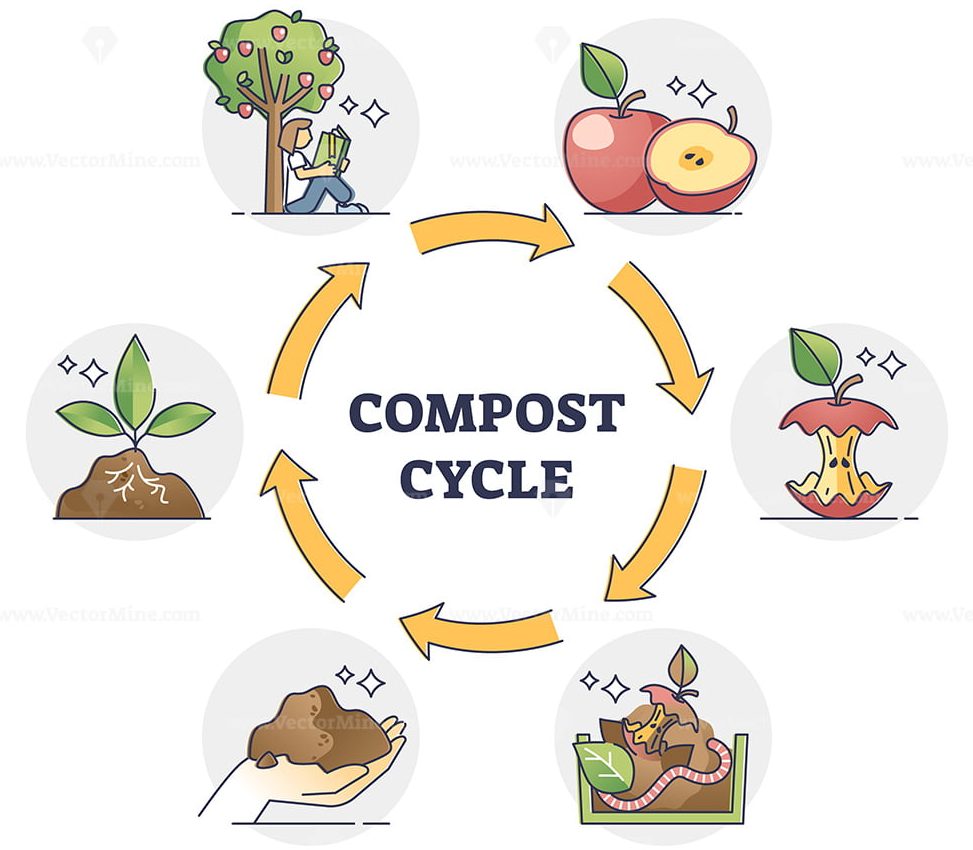
In our world, everything is interconnected: composting ends one process and begins another. Through the forces of fungi and countless microorganisms, the waste products of which are material decomposed into simple elements – compost, aka valuable vermicompost, which is perfectly absorbed by plant roots. This is how a new cycle of life begins. Plants absorb carbon dioxide, which is harmful to us, and release oxygen, which we inhale and create the fruits that we eat. Fertile soil and plants are the basis of life. Without this, life is unthinkable. But for life to continue naturally, the cycle must repeat itself in a natural way intended by nature: everything must return to the ground and, seasoned with fallen leaves, be composted, enriching it.
Fertile soil is the first thing that plants, animals and humans themselves need. It is worth understanding this well, as well as the fact that the use of synthetic mineral fertilizers has only a tactical meaning when the goal is not to take care of the soil, but to obtain a high yield in the short term for the planted crops. You should know that the plant absorbs only 5-10% of the volume of mineral fertilizers applied to the soil, but most of it remains in the soil and leads to a change in the natural balance, the destruction of humic acids, the destruction of beneficial microflora, which can ultimately lead to the complete destruction of the fertile layer soil.
Pure chemical elements contained in artificially created synthetic fertilizers have a positive effect only in a very short term, while they are water soluble. Subsequently, these elements accumulate, crystallizing the soil, changing its structure and composition, making it less suitable for organisms living in such soil.
With the constant use of synthetic fertilizers, soil degradation worsens, because its composition changes more and more. The elements introduced by rain penetrate deeper into the soil, entering the aquifer and reservoirs, changing their chemical composition.
With the active use of fertilizers, more and more watering will be required, since the soil, becoming less alive, holds water much worse. The root system in such soils is usually less developed, as it is difficult to germinate, which requires more frequent watering and increasing use of fertilizers, exacerbating the problem.
And this is without mentioning the herbicides and pesticides of all kinds that are used liberally in mass agriculture.
Soil degradation, desertification, low yields and the forced use of ever-increasing amounts of poisons and “fertilizers” are an undeniable truth, despite the silence and manipulation of public opinion that is used everywhere.
That’s why we suggest thinking about an organic and natural, humane and simple way of caring for the soil, for the sake of preserving all life on our planet.
Composting is a simple and natural, rational, humane and practical natural way of processing any decomposing waste into simple plant-digestible elements. This is a kind of return to nature of what we took from it, this is a way to thank and enrich it in a natural way, conceived by nature itself.
The importance of living soil
The soil for us humans is even more mysterious and less studied than the ocean and its depths, which, by the way, are less studied than the surface of the Moon and some planets. But up to half of the planet’s living biomass is hidden underground. Most of the living organisms inhabiting it cannot be seen without serious magnifying instruments, which is probably why they are less interested in them, and even neglected. But for plants, these tiny creatures mean a lot. One handful of good forest soil contains more living organisms than there are people on our planet, and all these organisms constantly influence the soil, transform it and make it so valuable and nutritious for plants.
Why is all this small fry, thousands of species with unpronounceable Latin names, of interest to science only in passing, while countless species remain completely unnoticed and unstudied? Maybe because they don’t seem all that cute on the outside?
However, they live everywhere, for example, in fallen leaves, which they greedily eat. Other species specialize in mushrooms and drink the juices they secrete. There is no food in nature for which there would not be its own species, and not just one, but hundreds and thousands of species, countless microscopic insects that exist in a stable relationship with each other. Thousands of their species, appearing on the verge of life and death, are eaten and processed many times, decomposing and ultimately turning any biomass into a valuable substrate for plants, after which the life cycle repeats.
These organisms are the end and beginning of the food chain. They create a necessary condition – soil, the basis of life, something without which life in all its diversity is unthinkable: from all the plants whose fruits we eat, to all animals without exception, and ourselves.